Crypto April 2026 Outlook: Regulatory Breakthroughs vs. Geopolitical Fires and Macro Tensions
April 2026 is a month of extreme friction. On one side, the March 17 commodity classification breakthrough; on the other, the dark clouds of the US-Israel-Iran conflict entering week 6. Mid-April's CPI data and the CLARITY Act markup will define the rest of the year.
Today is April 7. If you're only looking at the crypto price charts, you might be confused.
The March 17 SEC ruling that classified 16 tokens as commodities should have been the long-awaited bullish catalyst. Yet, Bitcoin continues to hover below $70,000, with sentiment briefly touching "extreme fear."
The reason isn't crypto-specific. Two heavy weights are pressing down: the US-Israel-Iran conflict, and stubborn inflation data. In the next three weeks, we'll witness a head-on collision between regulatory dividends and geopolitical risks.
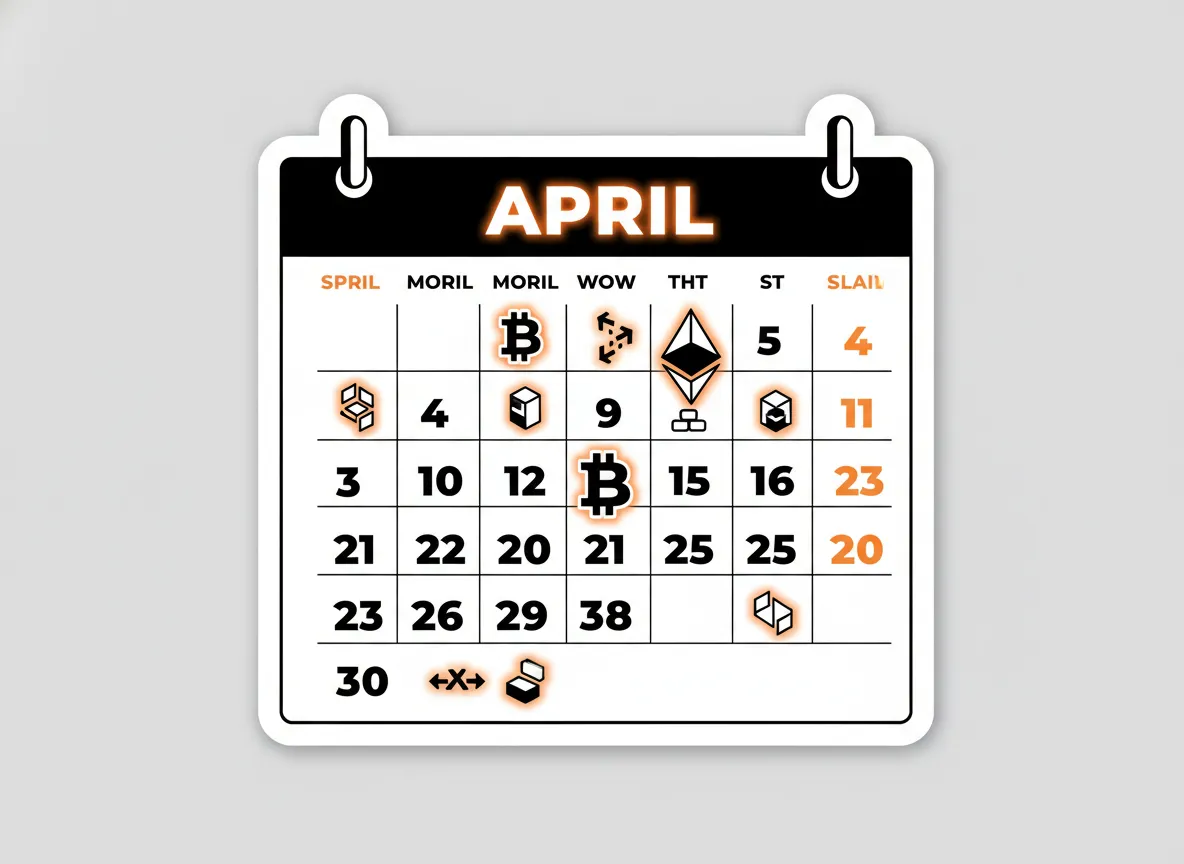
Key Dates at a Glance
| Date | Event | Category | Importance |
|---|---|---|---|
| April 8 | FOMC March Meeting Minutes Released | Macro Policy | ⭐⭐⭐⭐ |
| April 10 | March CPI Inflation Data | Macro Economy | ⭐⭐⭐⭐⭐ |
| April 13-18 | CLARITY Act Senate Banking Committee Markup | Regulation | ⭐⭐⭐⭐⭐ |
| April 14 | March PPI Release | Macro Economy | ⭐⭐⭐ |
| April 15-16 | Paris Blockchain Week | Conference | ⭐⭐⭐ |
| April 24 | Monthly Options Expiry (BTC/ETH) | Derivatives | ⭐⭐ |
| April 27-29 | Bitcoin 2026 Las Vegas | Conference | ⭐⭐⭐ |
| April 28-29 | FOMC Rate Decision (Powell's Final) | Macro Policy | ⭐⭐⭐⭐ |
| April 29-30 | TOKEN2049 Dubai | Conference | ⭐⭐⭐ |
| April 30 | March Core PCE Data | Macro Economy | ⭐⭐⭐⭐ |
| May 15 | Kevin Warsh Takes Over as Fed Chair | Macro Policy | ⭐⭐⭐⭐⭐ |
Geopolitical Chess: Week 6 of the US-Israel-Iran Conflict
The Return of the Risk Premium
Since the joint US-Israeli strikes on Iran on February 28, the conflict has entered its sixth week. The ongoing blockade of the Strait of Hormuz has pushed global energy supply chains to the limit—the strait handles roughly 20% of global oil trade. Brent crude surged past $107/barrel, with WTI stabilizing above $112.
This geopolitically-driven inflation is called a "secondary inflation pulse," and it directly compresses the Fed's policy space in Q2. Trump issued an ultimatum to Tehran in early April: reopen the strait by April 7, or face direct military strikes on Iranian infrastructure. This timeline became the core trigger for the month's volatility.
For Bitcoin, the behavior during this period has been split. During the initial escalation, BTC attracted some safe-haven flows as "digital gold"—but the tightening expectations from surging oil prices quickly took over, leading to a sharp drawdown on April 6-8. Oil is now functioning as a leading indicator for Bitcoin's short-term price path—not an opinion, just data.
The April Decision Point
If a phased ceasefire is reached by mid-April, falling oil prices will release massive liquidity pressure, likely triggering a relief rally in crypto. Conversely, if Iran continues blocking the strait or the conflict widens, global supply chain disruptions will force the Fed to remain extremely hawkish on the eve of its leadership change.
Macro Data: Inflation Hasn't "Soft Landed"
April 10: The Most Important Number of the Month
The CPI data released this Friday is April's first watershed moment. The backdrop is not encouraging: Core PCE has already bounced from 2.7% in January to 3.06%, persistently above the 2% target. The February Core PCE data releasing on April 9 will likely confirm this rebound, reinforcing "Higher for Longer" expectations.
Another data point to watch: March NFP came in at 178K, above expectations, but household surveys show uneven employment trends. On April 8, the FOMC will release March meeting minutes—details about how the Middle East situation affects the future rate path will directly determine market pricing for the April 28-29 meeting.
Trader's perspective: The current low volatility is essentially a wait-and-see game for the April 10 CPI data. Until then, any bounce could be a bull trap. Even if geopolitical tensions ease, sticky inflation from energy prices may limit liquidity expansion for digital assets in the near term.
The Fed Transition Shockwave
The April 28-29 FOMC meeting will likely be Jerome Powell's swan song as Chair. His term ends May 15, with Kevin Warsh confirmed as successor.
Warsh is known for his "Sound Money" stance, emphasizing balance sheet normalization. BTC has sold off after 8 of the last 9 FOMC meetings—a consistent "sell the news" pattern. If Warsh accelerates QT after taking over, liquidity gets tighter. But if falling inflation forces rate cuts, BTC could see a genuine breakout.
Regulatory Breakthrough: Impact of the 3.17 Ruling
Commodity "Immunity" for 16 Tokens
On March 11, the SEC and CFTC signed a joint regulatory MOU. On March 17, they released a 68-page interpretive rule classifying Bitcoin, Ethereum, Solana, XRP, Cardano, Chainlink, Avalanche, Polkadot, Hedera, Litecoin, Dogecoin, Shiba Inu, Tezos, Bitcoin Cash, Aptos, and Stellar as "digital commodities."
SEC Chair Paul Atkins put it plainly: the SEC is no longer the commission that regulates "securities and everything." The focus returns to actual investment contracts.
The practical impact was immediate:
- Exchanges listing these tokens no longer need to flag "potential securities risk"
- Institutional compliance memos have been updated from "do not hold" to "confirmed commodity, eligible for allocation"
- Staking, mining, and airdrops of non-security assets do not trigger securities law obligations
BlackRock's ETHB staking ETF (launched March 12) was legally "ratified." VanEck and Bitwise's SOL staking ETFs had their enforcement risk eliminated. Spot XRP ETFs attracted $1.44 billion in Q1 inflows—now with clear legal protection.
SEC's "Strategic Retreat"
Another signal that's easy to miss: the SEC decided in early March to withdraw some charges against Coinbase as an unregistered exchange. This reflects the regulator's difficulty in court—applying the 80-year-old Howey test to a highly modernized digital asset ecosystem is a stretch.
Coinbase subsequently received national trust charter approval in April, further solidifying its position as regulated infrastructure. For holders of compliant assets, this is a clear confidence boost.
CLARITY Act: April's Legislative Make-or-Break
SEC rules can be overturned by a future chair. Law cannot.
The CLARITY Act (H.R. 3633) is scheduled for Senate Banking Committee markup between April 13-18. Senator Moreno warned that if it doesn't pass by May, the election cycle will stall legislation indefinitely.
The Stablecoin Yield Controversy
The biggest battleground is stablecoins. The March 23 draft version leaned heavily toward banking interests—it explicitly prohibited crypto platforms from offering any bank-interest-like "yield" to stablecoin holders, allowing only minimal activity-related "rewards." Coinbase and other major trading platforms pushed back hard, arguing this would destroy stablecoin's liquidity engine.
After the Senate returns on April 13, bipartisan lawmakers are attempting to balance stablecoin yield against deposit safety. If the final provisions tilt too far toward banks, the compliance path for the entire DeFi ecosystem gets dramatically narrowed.
Polymarket currently shows 72% odds of passage in 2026. But if April markup fails, those odds drop sharply.
Token Unlocks: Supply Pressure That Can't Be Ignored
April continues to face selling pressure from large-scale unlocks:
| Token | Date | Size |
|---|---|---|
| Wormhole (W) | April 3 | 1.28B tokens (28% of supply) |
| Hyperliquid (HYPE) | April 6 | ~$375M |
| Ethena (ENA) | April 5 | ~$172M |
| Aptos (APT) | April 12 | TBD |
| Linea (LINEA) | April | 1.4B tokens |
Historical data shows 90% of unlocks create negative price pressure, often starting 30 days before the event. The real danger is liquidity exhaustion 7-14 days post-unlock.
Investment Strategy: How to Act Now
If you're a trend trader, keep leverage low before April 10. CPI data + CLARITY Act markup + ceasefire speculation—three layers of uncertainty stacked together will shake out high-leverage positions.
If you're a long-term investor, April might be an accumulation window. Regulatory frameworks are crystallizing, and commodity classification doesn't roll back. Assuming CLARITY Act progresses smoothly, sentiment could turn optimistic in Q2.
Asset selection logic:
- Conservative: Focus on tokens with minimal unlock pressure, solid fundamentals, and existing institutional products (BTC, ETH, SOL)
- Aggressive: Watch protocols in regulatory gray zones with clear roadmaps—they may gain explicit status in the next legislative round
Conclusion
April isn't a month for blind buying. It's a tug-of-war between geopolitical fires and regulatory dividends.
Three key nodes: April 10 (CPI), mid-April (CLARITY Act), April 28-29 (FOMC). One determines inflation expectations, one determines the regulatory framework, and one determines the liquidity environment.
Know the dates, spot the trend, survive April.
References:
- SEC/CFTC Joint Interpretive Rule on Digital Asset Commodities (March 17, 2026)
- U.S. Bureau of Labor Statistics: CPI Release Schedule 2026
- Phemex Research: SEC Crypto Ruling Impact (March 2026)
- Phemex Crypto Calendar: March-April 2026 Events
- Galaxy Digital: Fast-Tracking Digital Asset ETFs (August 2025)
- Federal Reserve FOMC Calendar 2026
- Keyrock: Token Unlock Analysis
- Polymarket: CLARITY Act Passage Probability